

Overview
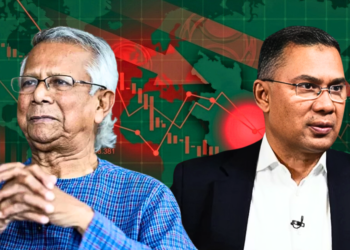
Political change often brings economic change, and Bangladesh is no exception. When a country moves from an interim government to a newly elected one, people closely watch how the economy reacts. Even within a short time, like one month, signs of stability or uncertainty can become visible in prices, business activity, and market trends. As when Dr. Muhammad Yunus was taking responsibility as interim government of Bangladesh, we saw the economic side. And at this topic, we also saw whether the elected government made any changes in the economic sector during its first month in power.
1. Introduction
In a country like Bangladesh, the economy is closely connected to political changes. Even a short period, like one month, can show clear changes in prices, business activity, and investor confidence. When a country moves from an interim government before an election to a new elected government, the economy often reacts quickly.
Comparing the economy over a short period, like one month before and after a government change, helps us quickly understand how the market reacts to political shifts. It shows immediate changes in areas like prices, investment, and business activity. Even though long-term data is important, short-term comparison reveals early signals—whether the economy is becoming stable, uncertain, or improving after new leadership takes charge.
2.Economic Snapshot: Last Month of Interim Government
Since becoming Chief Adviser of the interim government on August 8, 2024, Dr. Muhammad Yunus has led a period of major changes in the country. His main goal was to stabilize the situation after the July Uprising and prepare Bangladesh for democratic elections.The government took charge when the economy was weak, so they focused on fixing key problems, like, banking sector, control inflation rate, remittance, foreign reserve and so on.
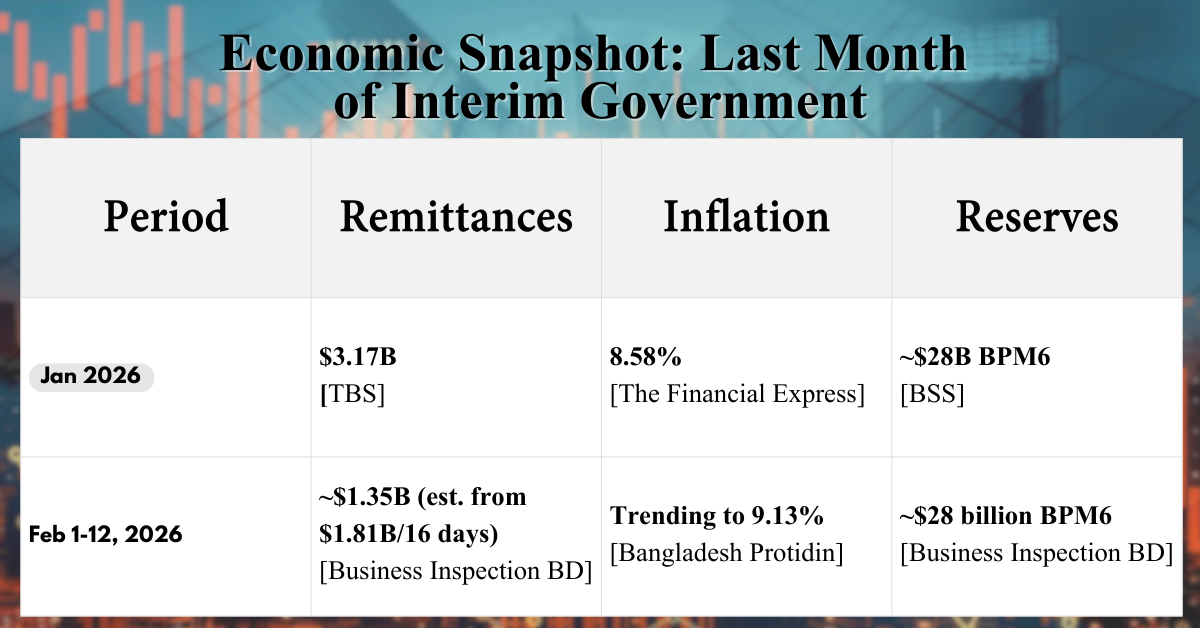
From January to February 12, 2026 which is the final weeks of Dr. Muhammad Yunus as interim Chief Adviser. In this period, Bangladesh’s economy remained fairly strong. The country received high remittances from abroad, which helped increase foreign reserves. However, inflation went up slightly during this period.
2.1. Remittances
In January 2026, Bangladesh received $3.17 billion in remittances, the third-highest monthly inflow ever, up 45% from January 2025. Experts attribute the rise to the decline of illegal hundi transfers and increased use of formal banking channels, boosted further by the recent change in government. It helped increase foreign reserves and ease exchange rate pressure, with the central bank buying nearly $4 billion to stabilize the market. Despite this, the current account deficit widened due to higher imports. [1]
Early February (first 16 days) reached $1.81 billion (+21% YoY), with daily averages ~$112.5 million; full February hit $3.02 billion (+19.5% YoY). Up to Feb 12, cumulative July-Feb inflows were ~$22.45 billion. [2]
2.2. Inflation Rate
In January 2026, inflation in Bangladesh slightly increased to 8.58%, mainly due to rising food prices ahead of Ramadan, according to Bangladesh Bureau of Statistics. Food inflation rose to 8.29%, while non-food inflation decreased to 8.81%. However, on a 12-month average basis, overall inflation slightly declined to 8.66%.[3]
In February 2026, inflation in Bangladesh rose to 9.13%, the highest in nine months, according to Bangladesh Bureau of Statistics. This is an increase from 8.58% in January, showing renewed pressure on living costs.
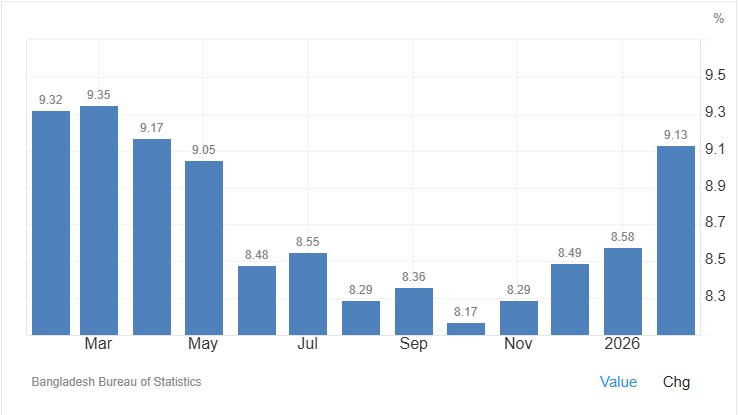
The rise was mainly driven by food prices, with food inflation increasing to 9.3%. Non-food inflation also went up slightly to 9.01%, reflecting higher costs in areas like housing and transport. Although inflation is still slightly lower than February 2025 levels, it remains high and continues to put pressure on consumers. [4]
2.3. Foreign Reserves
As of January 2026, Bangladesh’s foreign exchange reserves stood at $33.18 billion, according to Bangladesh Bank. However, based on the International Monetary Fund (IMF) BPM6 method, the reserves are calculated at a lower amount of $28.51 billion.[5]
In the first 16 days of February 2026, Bangladesh received $1.81 billion in remittances, which is 21% higher than last year. Strong inflows from expatriates led Bangladesh Bank to buy more dollars from local banks, increasing foreign reserves to $34.53 billion. On average, daily remittances reached $112.5 million, mainly coming from countries with large Bangladeshi communities, partly influenced by the upcoming national elections.[2]
3. Economic Snapshot: First Month of New Government
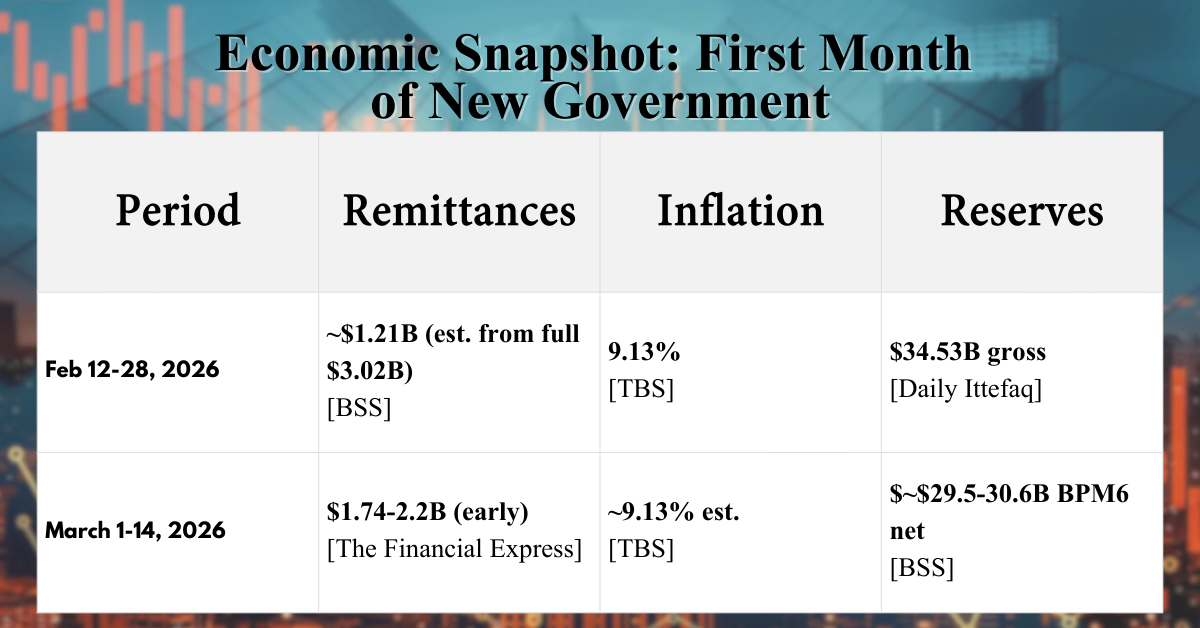
After the election, this is the first month of the new government under Tareque Rahman, as he takes power. From February 12 to March 2026, under the government of Tareque Rahman and Bangladesh Nationalist Party (from February 17), Bangladesh’s economy stayed stable. Remittances remained strong, which helped increase foreign reserves. However, inflation stayed high at the same level as earlier in the year.
Read more: Economic Situation During BNP’s Time Compared to Other
3.1. Remittances
In February 2026, Bangladesh received $3.02 billion in remittances, about 19.5% higher than the same month last year, according to Bangladesh Bank. During July to February of the 2025–26 fiscal year, total remittances reached $22.45 billion, up from $18.49 billion in the same period last year.[5]
In the first 14 days of March 2026, Bangladesh received $2.20 billion in remittances, a 35.7% increase compared to the same time last year, according to Bangladesh Bank. A large amount ($284 million) came between March 12–14, ahead of Eid-ul-Fitr. From July 2025 to mid-March 2026, total remittances reached $24.65 billion, showing strong overall growth. This increase is mainly due to a stable exchange rate and reduced use of illegal hundi channels after the 2024 political changes. Meanwhile, foreign reserves stood at about $34.54 billion (or $29.86 billion by International Monetary Fund standards). [3]
3.2. Inflation Rate
In February 2026, inflation in Bangladesh rose to 9.13%, the highest in 10 months, according to Bangladesh Bureau of Statistics. The increase was mainly driven by rising food prices, with food inflation reaching 9.3%, while non-food inflation also increased to 9.01%. Early March trends similar, no March CPI released yet. [1]
3.3. Foreign Reserves
As of February 2026, Bangladesh’s foreign exchange reserves stood at $35.03 billion, according to Bangladesh Bank. However, based on the International Monetary Fund (IMF) BPM6 method, the reserves are calculated at a lower level of $30.27 billion.[7]
In March 2026, Bangladesh’s foreign exchange reserves stayed stable and slightly upward-trending under the new Bangladesh Nationalist Party government, helped by strong remittances.
-
March 3: $35.33 billion gross ($30.58 billion BPM6 net)[5]
-
March 11: $34.29 billion gross ($29.57 billion BPM6 net)[5]
-
March 16: $34.22 billion gross (latest reported)[6]
Gross reserves remained around $34–35 billion, slightly below February’s $35.1 billion peak but above January’s $33.2 billion. Strong remittances of $2.2 billion in early March and ongoing dollar purchases helped maintain stability. BPM6 net reserves (~$29.5–30.6 billion) met IMF targets.
4.Comparative Economic Analysis
Under Dr. Muhammad Yunus, the economy is described as fairly strong, meaning that despite prior turmoil after the July Uprising, economic activity was resilient. Measures taken by the interim government, such as reforms in banking, remittance management, and foreign reserve support, contributed to this relative strength.
In the Tareque Rahman period, the economy stayed stable, indicating that the early government maintained continuity. There were no significant shocks or sudden growth spikes, suggesting that the transition between governments did not disrupt the economic momentum established by the interim administration.
4.1. Remittances
Remittances were a consistent positive factor in both periods. The continuation under the new government shows that the structural channels for foreign inflows (like banking reforms and anti-hundi measures) remained effective, allowing reserves to remain healthy without major disruptions.
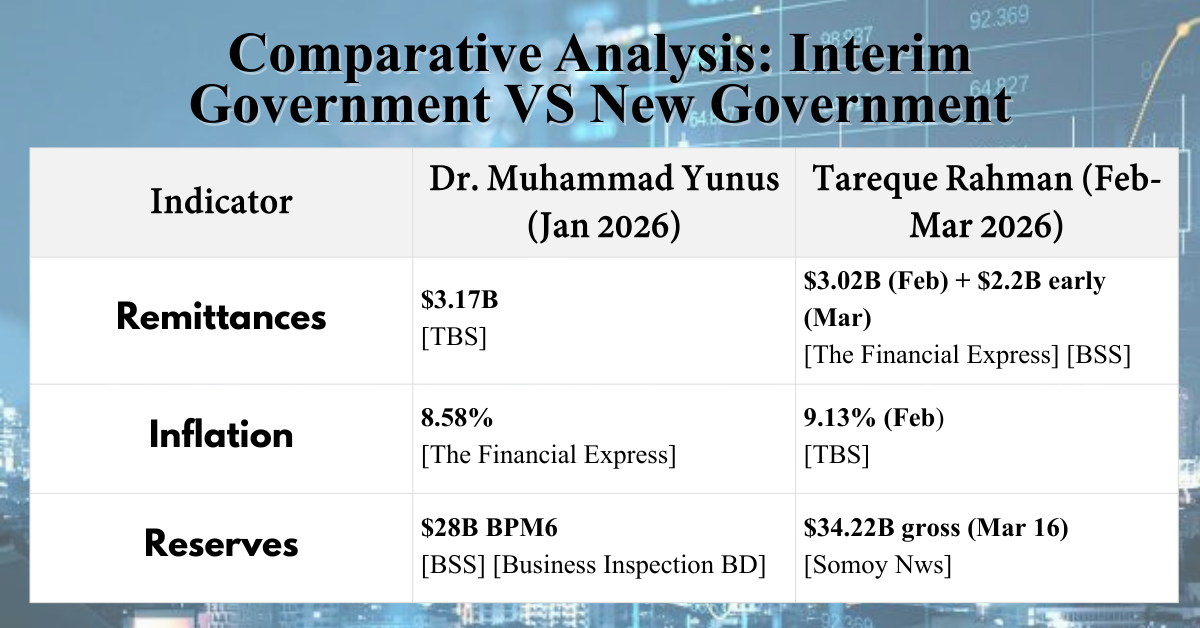
Dr. Yunus Period: High remittances helped increase foreign reserves, which was crucial for stabilizing the currency and ensuring liquidity in the market, it was $3.17B (+45% YoY peak) (Jan).[1]
Tareque Rahman Period: Remittances continued to remain strong, further supporting foreign reserves, Feb $3.02B (+19.5%), early Mar $2.2B (+35.7%) – strong but moderated growth.[3] [5]
4.2. Inflation rate
During the interim government, inflation showed a small upward trend, signaling emerging challenges. Under the new government, inflation plateaued, indicating a temporary stabilization of prices but also highlighting the persistence of economic pressures that needed longer-term policy intervention.
Dr. Yunus Period: Inflation increased slightly, possibly due to post-crisis adjustments, supply-demand mismatches, or global commodity price fluctuations, 8.58% (food 8.29%) (Jan).[3]
Tareque Rahman Period: Inflation remained high at the same level as earlier in the year, suggesting that while the new government maintained stability, inflationary pressures had not yet been fully addressed, 9.13% (10-month high, food 9.30%)(Feb).[1]
4.3. Foreign Reserve
Remittances were a consistent positive factor in both periods. The continuation under the new government shows that the structural channels for foreign inflows (like banking reforms and anti-hundi measures) remained effective, allowing reserves to remain healthy without major disruptions.
Dr. Yunus Period: High remittances helped increase foreign reserves, which was crucial for stabilizing the currency and ensuring liquidity in the market, ~$28B BPM6 (Jan). The first 16 days of February 2026, Bangladesh received $1.81 billion. [5] [2]
Tareque Rahman Period: Remittances continued to remain strong, further supporting foreign reserves, 9.13% (10-month high, food 9.30%)(Feb). [1]
5.Impact on Common People
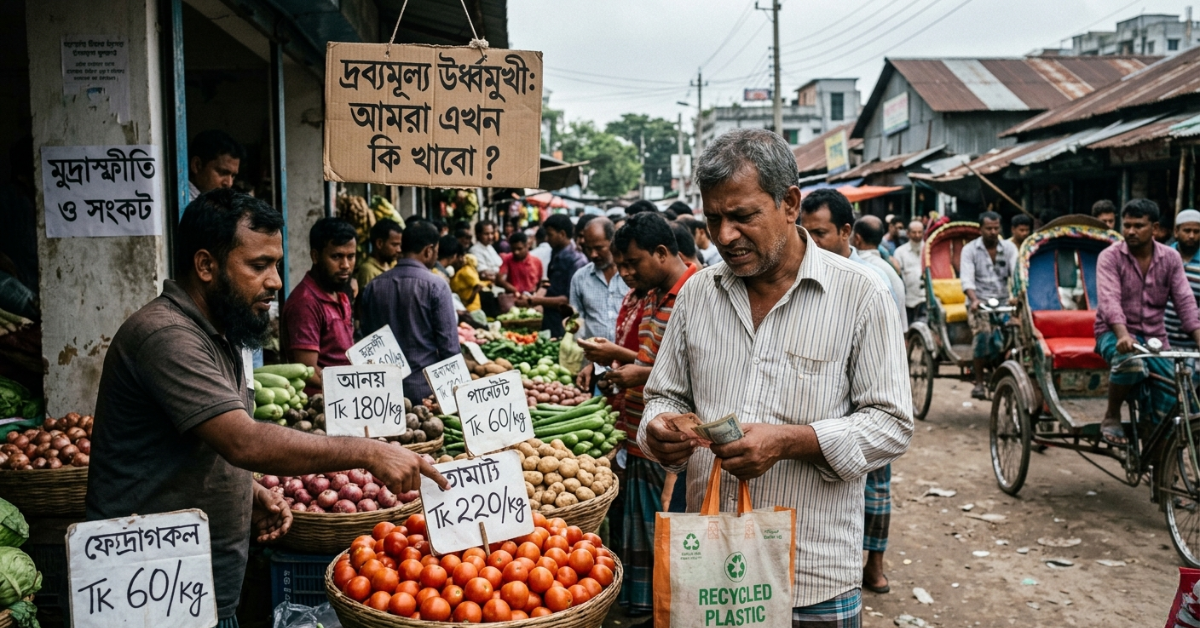
Bangladesh is experiencing its most severe cost-of-living crisis in recent history, with inflation among the highest in South Asia, projected at around 8.9% in 2025 and remaining high in 2026. Inflation increased from 8.17% in October 2025 to 8.58% in January 2026, driven largely by rising food prices, fuel costs, import expenses, and depreciation of the Taka.
The crisis disproportionately affects low- and middle-income households, who spend most of their income on food. Around 80% of the population are highly vulnerable to price hikes, and studies show that inflation impacts the poor far more than wealthier groups. Meanwhile, the rich continue to accumulate wealth, with growing numbers of millionaires and billionaires.
Despite limited private consumption, public spending remains low, constrained by weak tax collection (~6.8% of GDP in FY2025) and high debt servicing. Rising production costs further fuel inflation, creating a vicious cycle of price increases.
The Taka’s depreciation (from BDT 10 in 1979 to BDT 122 per USD in early 2026) has made imports more expensive, worsening inflation, while weak export growth and high import dependency drive a widening current account deficit.
The labor market is largely informal, with nearly 85% of workers in informal employment, and women disproportionately affected. About 2.7 million people became newly poor during the interim government’s tenure, with youth unemployment and income inequality worsening.
Overall, Bangladesh faces high inflation, slowing GDP growth, unemployment, and rising poverty, with the cost-of-living crisis hitting poor households hardest. Government intervention is urgently needed, including improving food supply chains, strengthening social safety nets, and controlling inflation to protect vulnerable populations.[3]
6.Conclusion
Bangladesh’s economy has been closely influenced by political changes, with both the interim government under Dr. Muhammad Yunus (Aug 2024–Feb 2026) and the newly elected Tareque Rahman-led BNP government (from Feb 17, 2026) maintaining relative stability in the short term.
During the interim government, high remittances (e.g., $3.17B in Jan 2026) and reforms like anti-hundi measures helped boost foreign reserves (~$28B BPM6) and stabilize the currency. Inflation rose slightly (8.58% in Jan) due to food price pressures, while economic activity remained resilient despite the post-crisis environment.
Under Tareque Rahman’s early government, remittances continued strong ($3.02B in Feb, $2.2B in early Mar), supporting foreign reserves (~$34–35B gross), while inflation remained high (9.13% in Feb), showing price pressures had not yet eased. Overall, the transition did not disrupt economic momentum, though challenges persisted.
Cost-of-living pressures remain severe, with Bangladesh facing one of the highest inflation rates in South Asia. Rising food and fuel prices, Taka depreciation, import dependency, and weak export growth have heavily impacted low- and middle-income households, while wealthier segments remain largely unaffected. The labor market is mostly informal, and income inequality and unemployment, especially among youth, have worsened.
The economy faces high inflation, slowing GDP growth, and rising poverty, highlighting the urgent need for government action, including strengthening social safety nets, improving food supply chains, and controlling inflation to protect vulnerable populations.
References
1.TBS
2.Business Inspection BD
3. The Financial Express
4.Bangladesh Protidin
5.BSS
6.Somoy News
7.Daily Ittefaq