

Overview
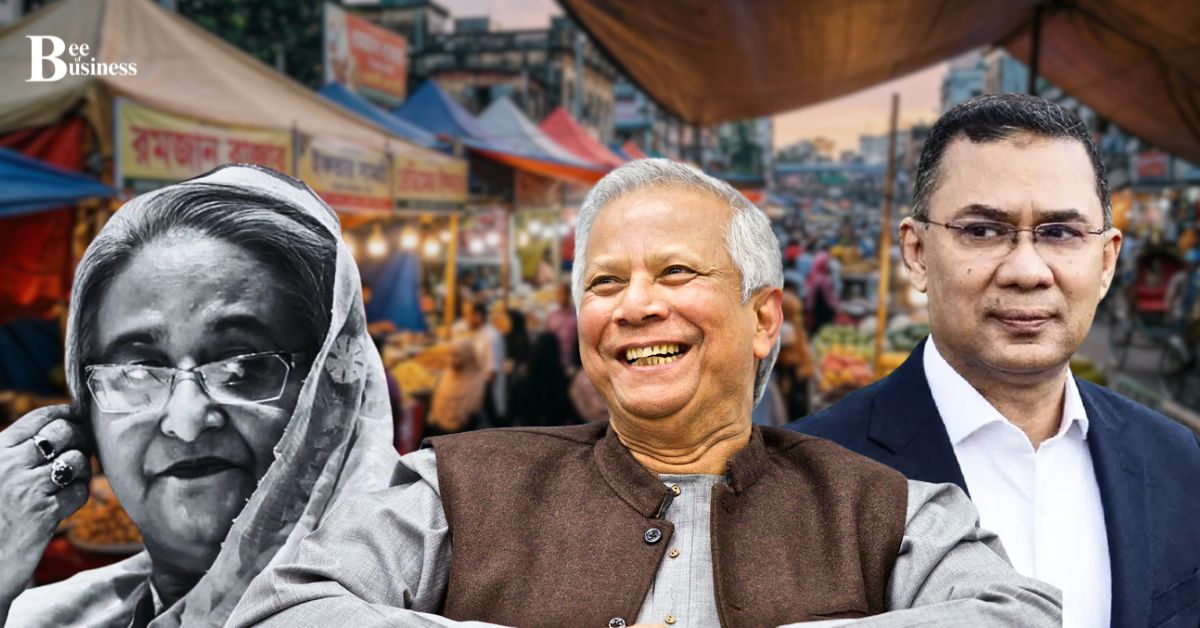
This research examines the Ramadan market conditions in Bangladesh during the years 2024, 2025, and 2026. It compares the performance and policies of three different governments: the Awami League government (2024), the Interim Government (2025), and the Bangladesh Nationalist Party (BNP) government (2026). Overall, this research provides a comparative view of how the three governments shaped the market environment during a high-demand period and highlights the importance of effective planning and monitoring to ensure stable and fair prices for consumers.
1. Introduction: Role of Deferent Governments in Ramadan Markets
The government of Awami League (2024), the interim government (2025), and the new BNP government (2026) each played different roles in managing Ramadan markets in Bangladesh. 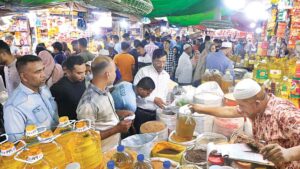 During Ramadan, demand for food items like rice, chickpeas, sugar, oil, dates, and meat rises, which can make prices go up. This study aims to compare how these three governments managed the Ramadan market and how their actions affected prices and consumers.
1.1 Ramadan Market Trends Under Sheikh Hasina’s Government
During Sheikh Hasina’s government, Bangladesh experienced steep increases in essential food prices during Ramadan. In last 15 years since Awami Government, the price of beef rose by 350%, coarse rice by 100%, and chickpeas by 100%.
1.2 Rising Prices of Essential Food Items
This year, the biggest price shock was dates, which remained high at Tk 300/kg despite reduced import duties. Other essentials also increased significantly:
- cucumbers and tomatoes reached Tk 100-120/kg
- lemons/limes Tk 100-120/kg
- sugar Tk 155/kg
- local onions Tk 90/kg
- potatoes Tk 35/kg
- broiler chicken Tk 220/kg.
Prices of Key Ramadan Products in Local Markets:
During Ramadan, many products remained expensive:
- Beef was selling at around Tk 700–800 per kg.
- Sugar was around Tk 140–155 per kg.
- Chickpeas were about Tk 120 per kg.
- Local onions and other essentials also maintained high rates compared to past years. [1]
1.3 Factors Behind Persistent Price Increases
Experts and traders attributed these price increases to market manipulation and syndicate activities. Many reports noted that traders hoarded goods to create artificial shortages, which drove up prices during high demand periods like Ramadan. Consumers also demanded stronger government action against unfair pricing and syndicates. [2]
Despite having multiple ministries and agencies—such as the Ministry of Commerce, TCB, Directorate of National Consumer Rights Protection, Bangladesh Competition Commission, and others—to monitor the market, isolated interventions have failed to significantly stabilize prices. Experts argue that systemic problems, including poor supply chain management, lack of coordination among agencies, and insufficient oversight of imports and distribution, placed immense pressure on ordinary citizens, making Ramadan essentials unaffordable for many. [1]
2. Ramadan Market Situation Under the Interim Government
During Ramadan 2025, Bangladesh experienced mixed trends in food prices, where some essential items became more affordable compared to the previous years of 2025. This brought a level of relief to consumers, especially for daily cooking items.
2.1 Mixed Price Trends in Essential Food Items
Several key products showed a noticeable price decrease:
- Najirshail and Miniket rice: decreased by Tk 2 per kilogram
- Non-brand wheat flour: dropped by Tk 5 per kilogram
- Eggs: around Tk 125 per dozen
- Local onions: reduced to Tk 40 per kilogram
- Green chilies: dropped significantly by about Tk 50 per kilogram (compared to March 2024)
Overall, these price reductions helped ease the pressure on consumers during Ramadan, although the market still showed some fluctuations in other items. In comparison, during the government under Sheikh Hasina, staple food prices during Ramadan were often higher.
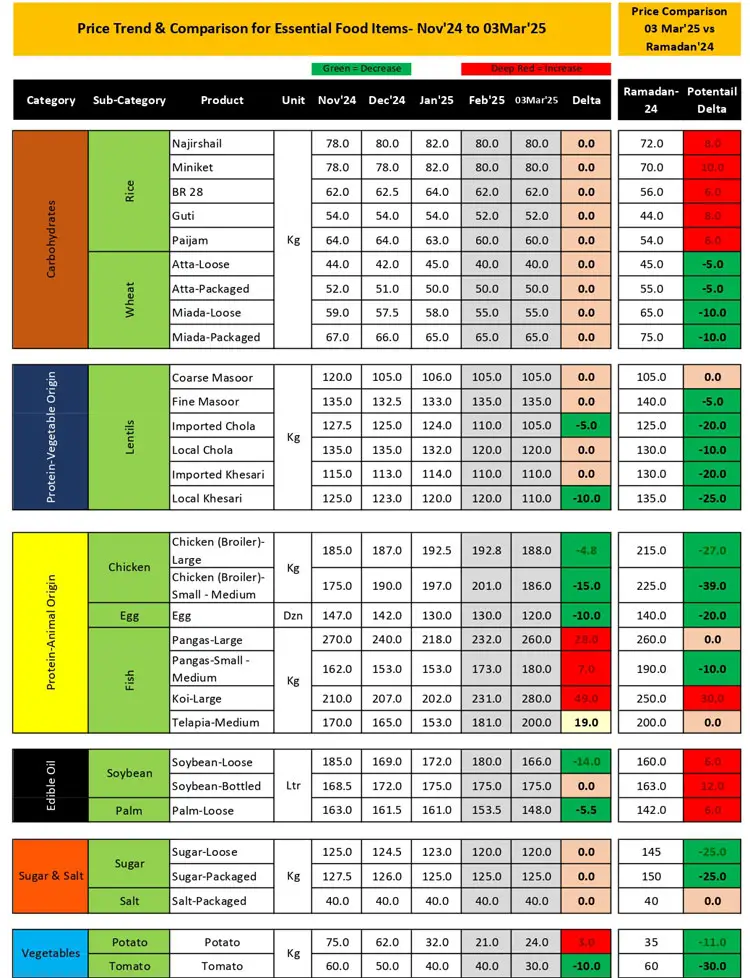
Rice, onions, lentils, and poultry frequently experienced sharp price increases, which made basic meals more expensive for families. The Interim Government in 2025 has managed to stabilize some of these essentials through interventions like the Trading Corporation of Bangladesh, keeping basic cooking ingredients more affordable. [3]
2.2 Government Interventions to Stabilize Prices
The interim government introduced several market interventions to keep Ramadan essentials affordable. Through the Trading Corporation of Bangladesh (TCB), subsidized products such as rice, oil, and pulses were sold through truck sales across major cities. These initiatives aimed to increase supply and reduce pressure on retail markets during the fasting month. [4]
2.3 Higher Prices for Protein and Imported Items
Despite the decline in some staple goods, protein sources and imported items remained expensive during Ramadan 2025, creating pressure for many consumers. Several items showed noticeable price increases:
- Large pangas fish: increased by about Tk 32 per kilogram
- Tilapia fish: increased by about Tk 37 per kilogram
- Koi fish: increased by about Tk 48 per kilogram
- Imported Indian ginger: increased by about Tk 18 per kilogram
These rising prices show that import costs and supply issues still affected certain products, even when some basic items became cheaper. Overall, while staples are cheaper under the 2025 Interim Government, market volatility continues to affect shoppers, highlighting the ongoing challenge of balancing affordability and supply during Ramadan. [5]
Read More: Economic Situation During BNP’s Time Compared to Other
4. Ramadan Market Outlook Under the Current BNP Government
Retail data shows that prices of many essential items became stable or decreased, helping improve the overall market situation during Ramadan 2026.
4.1 Declining or Stable Prices of Essential Items
Key price changes include:
- Chickpeas: dropped from Tk 110 to Tk 80–90 per kg
- Sugar: decreased from Tk 105 to Tk 95 per kg
- Lentils: reduced from Tk 100–110 to Tk 80–85 per kg
- Loose soybean oil: slightly higher at Tk 175–180 per litre
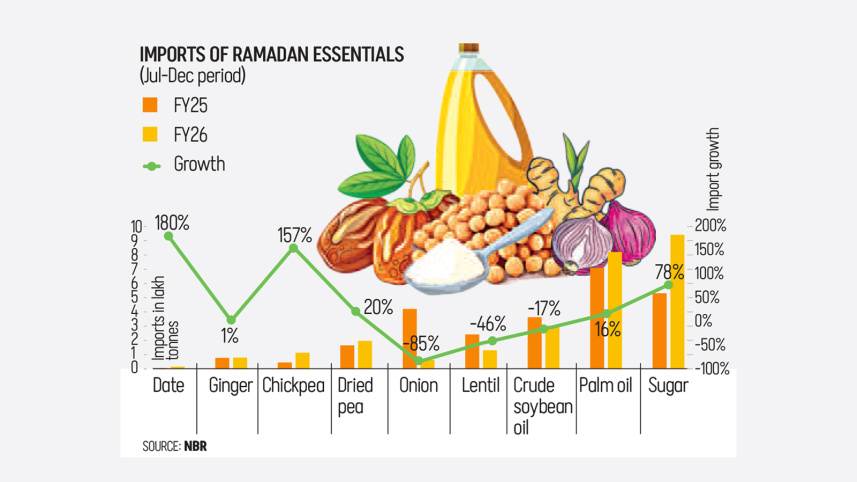
Other important trends:
- Dates: expected to decrease by Tk 30–35 per kg due to higher imports and lower duties
- Onions and lentils: likely to remain stable because of strong local production during Ramadan
Overall, better supply and increased imports helped keep prices stable, even though a few items remained slightly expensive. [5]
4.2 Higher Imports Ahead of Ramadan
Ahead of Ramadan 2026, Bangladesh increased imports of essential food items to stabilize the market. Between July and December 2025, the country imported 26.64 lakh tonnes of commodities, including lentils, edible oil, chickpeas, onions, ginger, dates, and sugar. This was about 4.1% higher than the same period a year earlier. Lower import duties and improved dollar availability helped traders bring in more goods, ensuring sufficient supply in the market.
During Ramadan 2026, retail data showed that prices of many essential items were either falling or remaining stable, offering some relief to consumers:
- Chickpeas experienced a noticeable drop, falling from around Tk 110 to Tk 80–90 per kg.
- Sugar also became cheaper, decreasing from Tk 105 to Tk 95 per kg.
- Lentils saw a reduction, moving from Tk 100–110 down to Tk 80–85 per kg.
- Loose soybean oil remained slightly higher at Tk 175–180 per litre, but overall availability was sufficient to meet demand.
- Dates, benefiting from increased imports and reduced import duties, were expected to fall by Tk 30–35 per kg.
- Onions and lentils were projected to remain steady thanks to overlapping domestic production during the Ramadan season.
Overall, these trends indicate that higher imports, better planning, and coordinated market management helped maintain stability in essential food prices during Ramadan. [5]
4.3 Impact of Increased Imports on the Ramadan Market
Higher imports also affected other products. Dates are expected to become Tk 30–35 cheaper per kg due to increased supply and reduced import duties. Onions and lentils are also likely to remain stable because local production overlaps with Ramadan demand, helping maintain market balance.
The government and commerce ministry credit this stability to increased imports, steady foreign currency availability, and proactive planning with traders. Commerce Adviser Sk Bashir Uddin emphasized that imports have risen by 40% compared to last year, making Ramadan 2026 more affordable. If supply conditions hold, prices of several key items may even fall, contrasting sharply with the volatility seen under Sheikh Hasina’s government, when hoarding and syndicates often caused sharp price hikes during Ramadan. [5]
5. Comparison of Ramadan Essential Commodity Prices Under Three Government
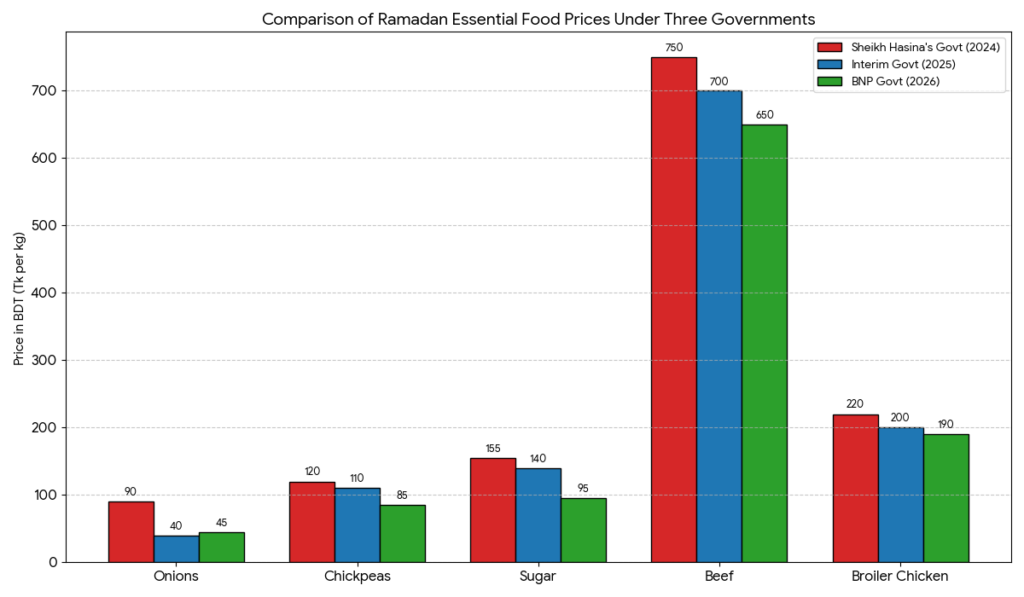
The comparison of Ramadan markets in Bangladesh from 2024 to 2026 shows clear differences in prices. In Ramadan 2024, reports showed that prices of many essential items rose sharply soon after Ramadan began, making Ramadan shopping more expensive for ordinary people. Items like eggplants, chillies, cucumber, tomatoes and other kitchen essentials saw noticeable increases in price. Many consumers expressed disappointment, saying the promised price stability did not happen in practice. [5]
In Ramadan 2025 and 2026, government efforts to control the market. Authorities arranged special sales where items like eggs, milk, and meat were sold at lower prices. There were also reports about better supply and imports to keep prices stable during Ramadan. Although some products still had price changes, the overall tone became more balanced compared to 2024. [4]
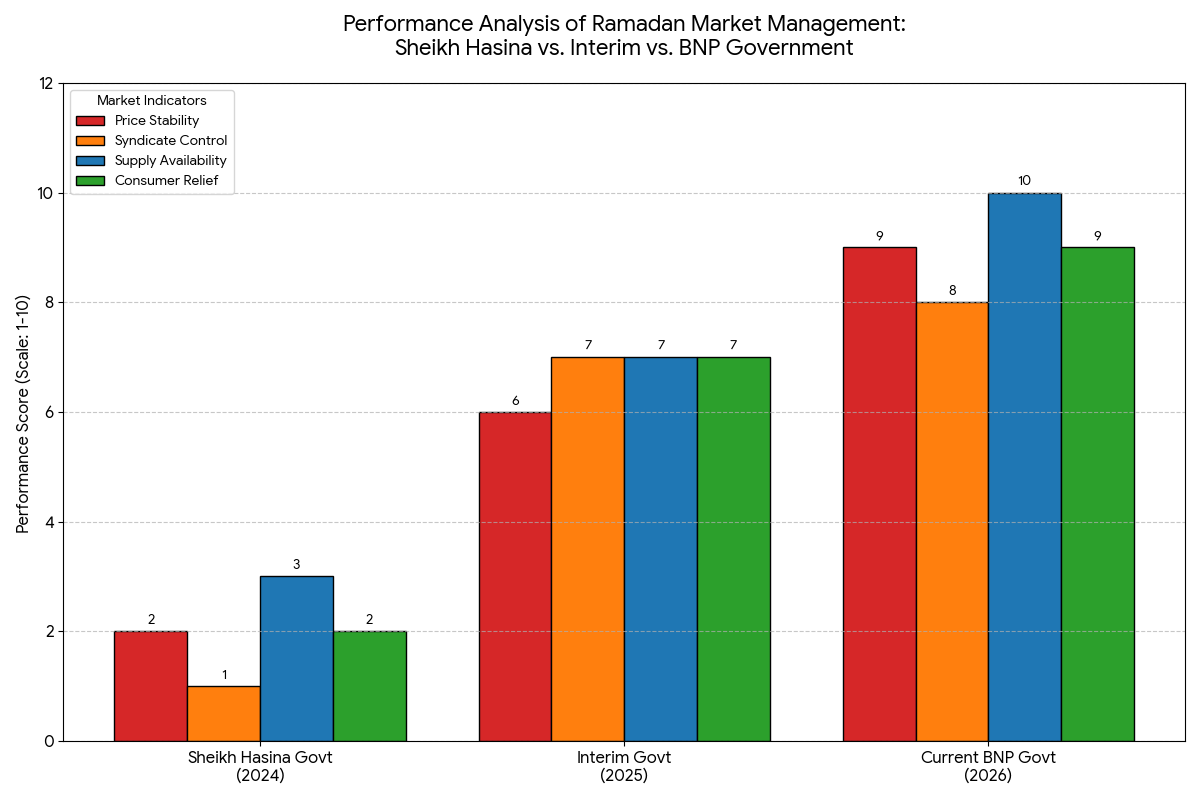
6. Overall Ramadan Market Situation in Bangladesh Under Different Governments (2024–2026):
| Year | Government Situation | Market Situation Reported | ||
|---|---|---|---|---|
| 2024 | During Awami league government | Price hikes, inflation, trader syndicates | Many essentials like rice, onions, sugar, and beef increased in price; consumers complained about high costs | |
| 2025 | Interim government | Government intervention and market monitoring | Government launched low-price sales of eggs, milk, and meat; mixed price trends reported | |
| 2026 | New Government BNP | Market stability, supply assurance | Authorities highlighted sufficient stock and higher imports; some local subsidized Ramadan markets were introduced |
7. Conclusion:
Each government played a different role in managing Ramadan markets in Bangladesh. In 2024 under Sheikh Hasina, prices often rose sharply. In 2025, the Interim Government stabilized some staple items through interventions. By 2026 under the BNP, higher imports and better planning helped keep prices stable and goods available. This shows that government actions directly affect market stability and affordability during Ramadan.
References: